Author Archives: Alex De-Gruchy

13 Post-Millennium Horror Games You Should Play – Part 1

Nefarious1

The video game medium has evolved and advanced at great speed over the past few decades – playing something like Dark Souls, The Last of Us, or Grand Theft Auto 5 would have been the stuff of a madman’s dreams just twenty years ago.

    The advancement of not only technology but also creative visions as to what can be achieved with the medium has affected all genres, horror included. We’ve come a hell of a long way since the days of Friday the 13th on the Commodore 64 and Ghost House on the Sega Master System, with developers becoming able to create horror games that can genuinely unsettle, disturb, frighten, or simply effectively jump-scare the player via the use of intelligent writing, clever game design and gameplay mechanics, and the increased immersion that can come with improved visuals and audio.

Continue reading

Tagged , , , , , , , , , , ,

A Journey Through Dark Souls At SL1: Part 2

SuchHeroicNonsense2

* Note: Spoilers ahead regarding some of the characters, locations, enemies, and events of Dark Souls.

[This is part 2 of a 2 part series. Part 1 is available here]

Thirty-two.

    It’s not a particularly large number, is it. It’s no thirty-three, for instance. Or four-billion-and-seven. But thirty-two can be plenty, depending on the circumstances.

    “Ornstein and Smough. Soul Level 1. 32 attempts. FUCKING DONE. HAVE THAT, YOU PAIR OF GOLDEN BASTARDS.”

    The above was a text message I sent early on a Sunday morning to a friend and fellow Dark Souls player after finally defeating the boss duo of Dragon Slayer Ornstein and Executioner Smough – on my thirty-second attempt. Yes, I counted.

    But let’s backtrack slightly.

Continue reading

Tagged , , , , , , , , ,

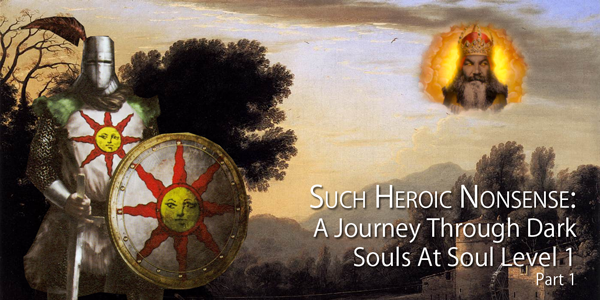
A Journey Through Dark Souls At SL1: Part 1

SuchHeroicNonsense

“I got a bad feeling about this.” – Han Solo.


* Note: Spoilers ahead regarding some of the characters, locations, enemies, and events of Dark Souls.


You’re standing in a cave. Lying asleep on the ground before you is a huge male bear, the massive beast lying on his back, snoring. Covered in thick, dark fur, with claws and teeth that are long and sharp, the bear is one of nature’s killing machines.

    In your hands is a wet towel. You look down at it, then at the sleeping bear. Then you quickly spin the towel around and flick it outwards with all the force you can manage, snapping the towel against the bear’s testicles.

    The bear wakes with a start. At first, his expression shows confusion, surprise, and pain. Then his eyes focus on you, his teeth clamp together in a snarl, and a furious, murderous frown creases his brow as he glares at you.

    As the bear rises to its full height, towering over you, his eyes never leaving yours as he lets out a loud roar, you begin to feel a terrible sinking feeling in your stomach, and one simple truth passes through your mind: I brought this on myself.

    This was the situation I found myself in as I took on Dark Souls at Soul Level 1. Whatever crushing defeats and punishing challenges awaited me, however many seemingly undefeatable enemies and brutal deaths… I brought this on myself.

Continue reading

Tagged , , , , , , , , ,

A History of the Side-Scrolling Beat-‘Em-Up – Part 2

Taste the fist

By the late 1980s, the side-scrolling beat-‘em-up genre had become hugely popular amongst gamers, especially in the arcades, so it was no surprise that some companies who held licences to existing products of other mediums attempted to take advantage of this and create video games that applied a popular license to a popular genre.

    A good example was the arcade title Teenage Mutant Ninja Turtles, which I talked about in Part 1, and this was far from the last video game to feature the Turtles in an effort to exploit their popularity: the arcades later received the sequel Teenage Mutant Ninja Turtles: Turtles In Time, which was also released on the Super Nintendo, while some Turtles beat-‘em-ups exclusive to home systems included Teenage Mutant Ninja Turtles III: The Manhattan Project on the NES, and Teenage Mutant Ninja Turtles: The Hyperstone Heist on the Sega Mega Drive, although the latter title borrowed heavily from Turtles In Time.

    And I am now officially sick of writing the word “Turtles”.

Continue reading

Tagged , , , , , , , , , , , , , , , , , , ,

A History of the Side-Scrolling Beat-‘Em-Up – Part 1: A History of Violence

Hammer time

It can be easy for some gamers to write off the side-scrolling beat-‘em-up genre as shallow and repetitive, especially when taking into account how the medium of video games has evolved and matured over the past two decades, but this is doing the genre a disservice.

    Side-scrolling beat-‘em-ups have actually taught us some interesting and valuable things, such as how breaking open a metal bin or a wooden barrel or crate can potentially reveal a delicious whole roast chicken or some similar food hiding within, and how eating such hidden food (well, more “absorbing” than eating) can instantly heal you no matter how badly you’ve been beaten, stabbed, burned, and generally battered.

Continue reading

Tagged , , , , , , , , , , , , , , , ,

Retrospective: Blood Omen: Legacy of Kain

Bring on the Kain

“I didn’t care if I was in Heaven or Hell – all I wanted was to kill my assassins. Sometimes you get what you wish for. The Necromancer Mortanius offered me a chance for vengeance. And like a fool, I jumped at his offer without considering the cost. Nothing is free. Not even revenge.” – Kain

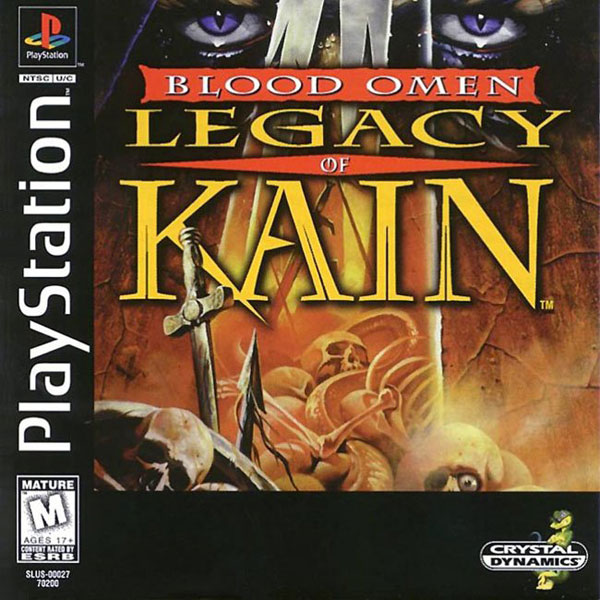
One of the most magnificent bastards in video games, Kain the vampire began his undead life in the 1996 PlayStation title Blood Omen: Legacy of Kain (the game receiving the more to-the-point title of Kain the Vampire in Japan), an action-adventure game featuring RPG elements, with two-dimensional graphics and a fixed top-down camera.

Blood Omen Legacy of Kain - cover

At the time of Blood Omen’s development and release, storytelling in console games was still emerging from its infancy, from the days when the plots to so many games featuring any kind of narrative followed the basic “Defeat villain + save princess and / or world = success” formula, and when characterisation carried about as much weight in the game development process as an anorexic midget.

But Blood Omen and protagonist Kain were very different beasts. Story and characterisation were placed at the heart of the game right from the very beginning, with Kain turning out to be a complicated and multilayered character. Ostensibly an undead monster who fed on the living, Kain was indeed violent, arrogant, and ruthless, but there was more to him than that – during the course of the story, Kain was also shown to be intelligent, nostalgic regarding his homeland but contemptuous of his former life, appreciative of beauty, disdainful of political machinations, and afraid of transforming into an utterly twisted and depraved monster.

Continue reading

Tagged , , , , , , , , , , , , , , ,

Retrospective: Sonic Adventure

sonica

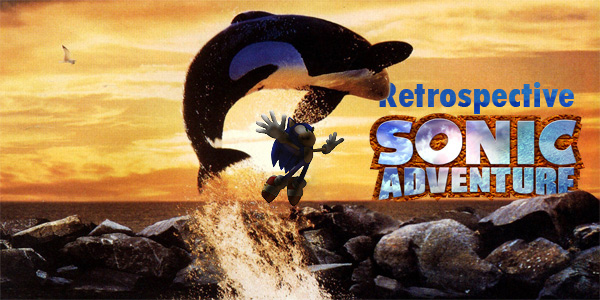
“SweetJesuslookatthatwhalethatlooksawesome!”

That – or something along those unpunctuated lines, anyway – was the thought that ran through my head the first time I saw Sonic Adventure in action.

I was about 18 years old, a bright-eyed and bushy-tailed university student with a smile on my lips and a song in my heart, years before I became the angry, whiskey-soaked misanthrope I am today. I was in Another World (a shop that sold video games, comic books and other cool stuff), and they had a then-brand-new Sega Dreamcast on display, the console hooked up to a TV monitor showing a Sonic Adventure gameplay demo on a loop.

The demo in question showcased the game’s opening level, Emerald Coast, the highlight being the now-famous sequence where Sonic sprints along a wooden bridge, closely pursued by a killer whale leaping through the water and smashing the bridge behind him. It was a brief sequence but also a thrilling and visually spectacular one that helped launch the blue hedgehog onto a new console generation in style. I bought a Dreamcast soon afterwards. (And later sold it to pay the rent, but that’s another story).

Continue reading

Tagged , , , , , , , , , , , ,

The Bizarre and Brilliant Video Game World of Goichi Suda

suda51

When people discuss Japanese video game designer and director Goichi Suda, the subject of film directors who could be considered auteurs often arises in connection, with Suda being compared to David Lynch (Blue Velvet) and Alfred Hitchcock (Psycho), amongst others – inventive and creative directors unafraid to take risks, and whose bodies of work exhibit signature characteristics and elements which clearly identify a particular director’s work as his own. This despite the fact that filmmaking is a traditionally – and almost fundamentally – collaborative effort, as is the case with video games, to a certain extent.

It’s not just the medium of film that’s often brought up but music as well. Suda is a huge and lifelong fan of music, and he and development studio Grasshopper Manufacture, of which he is CEO, proudly proclaim their own “punk attitude” when it comes to video game creation, the company slogan being “Punk’s Not Dead.”

Continue reading

Tagged , , , , , , , , , , , , , , , , , , , ,